Paddleboarding Fundamentals
*We may earn a commission for purchases made using our links. Please see our disclosure to learn more.
Paddleboarding Fundamentals: Essential Techniques for Beginners to Master Balance and Control
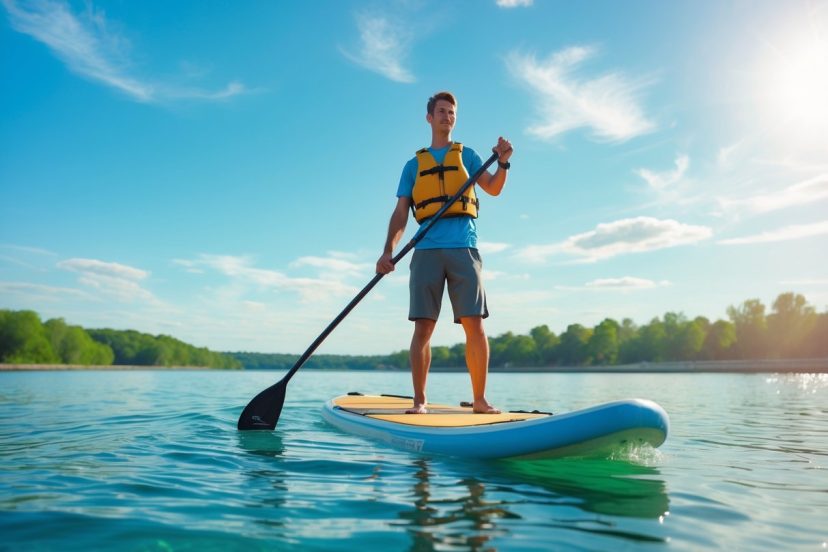
Paddleboarding is a water sport where you stand on a large board and use a paddle to move across the water. It’s easy to learn and offers a great workout while letting you enjoy lakes, rivers, and oceans. I’ve found that most beginners can get comfortable on a board within their first session.
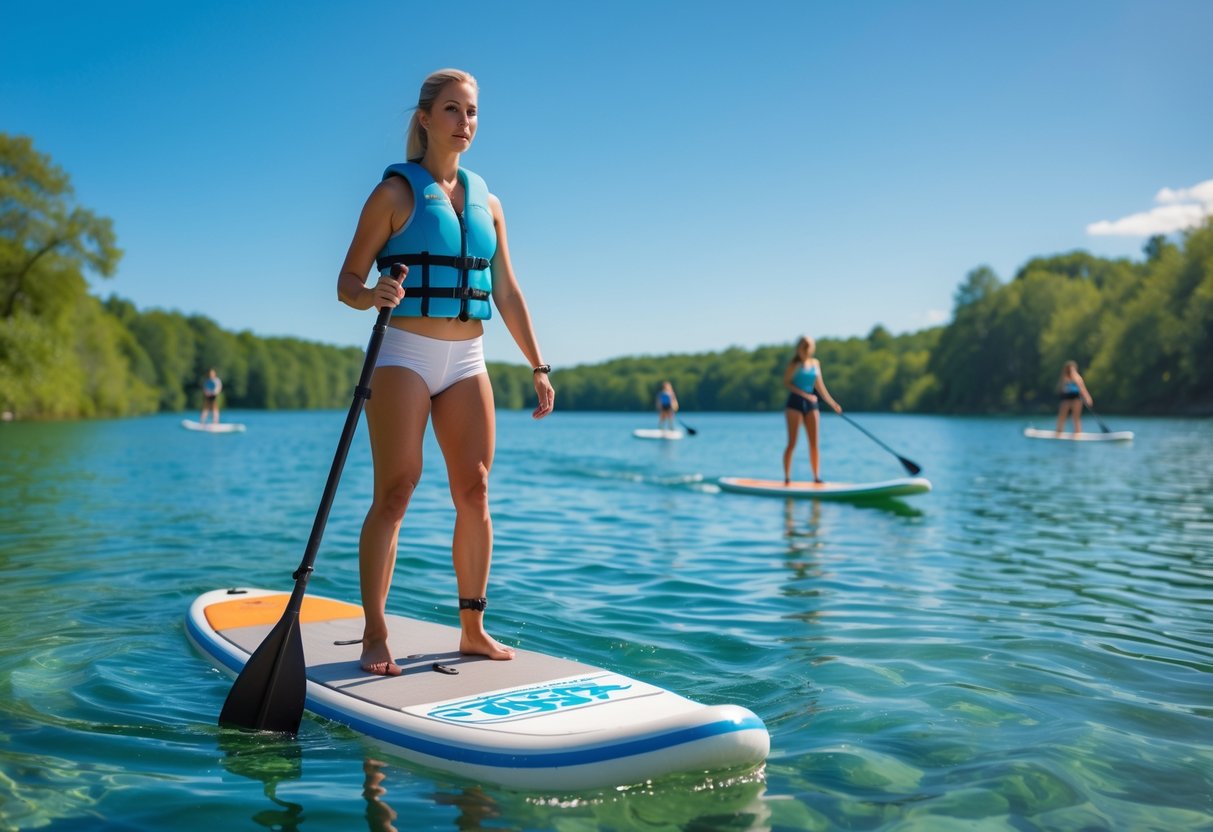
The key to paddleboarding is understanding the basic equipment you need, learning proper technique, and following important safety rules. You don’t need to be an athlete or have perfect balance to start. With the right approach, anyone can pick up this sport.
In this guide, I’ll walk you through everything from choosing your first board to building your skills on the water. You’ll learn what gear matters most, how to stand and paddle correctly, and ways to stay safe while you’re out. I’ll also cover different types of paddleboarding you can try as you get more experienced.
What Is Paddleboarding?
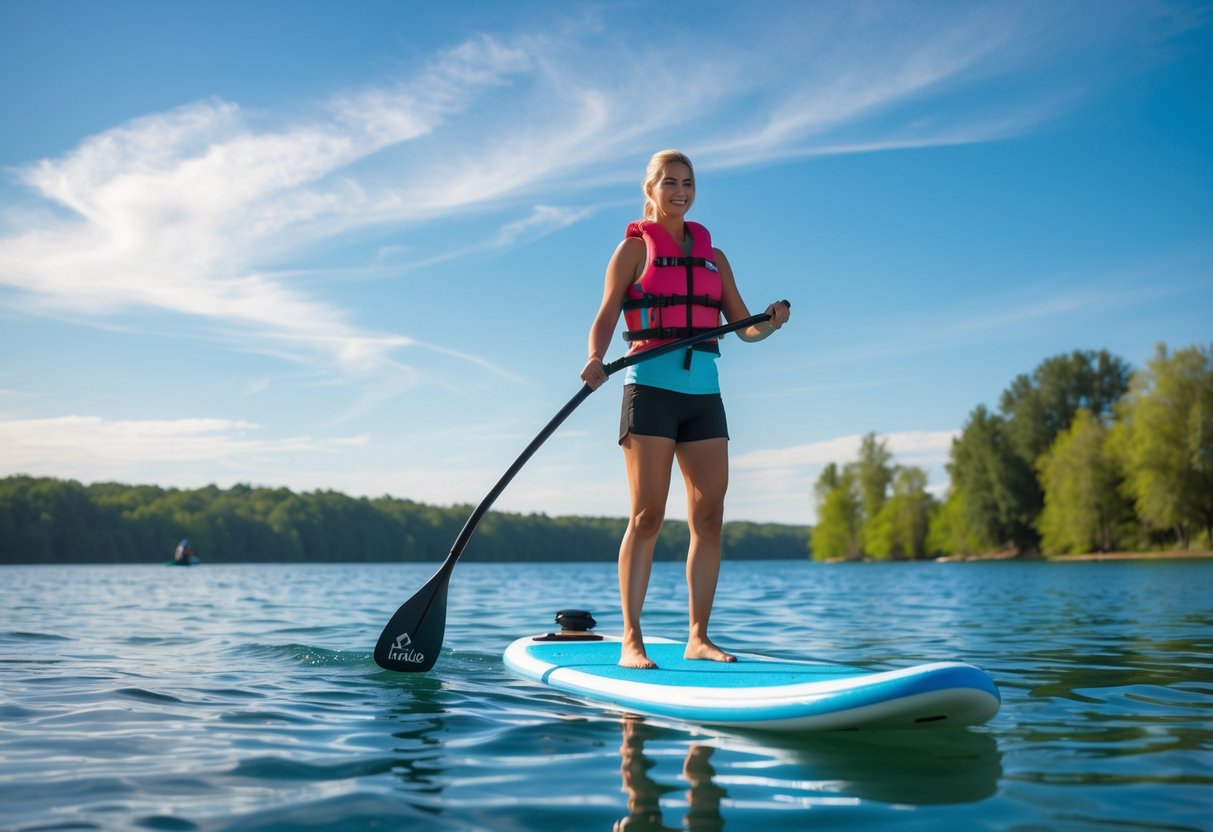
Paddleboarding is a water sport where you stand on a large, buoyant board and use a long paddle to move across the water. The activity originated from ancient Polynesian cultures and has grown into a popular modern recreation that works your whole body while you explore lakes, rivers, and oceans.
History and Evolution of Paddleboarding
Paddleboarding traces back thousands of years to ancient Polynesian and South American cultures. People in these regions stood on wooden boards and used paddles to fish, travel between islands, and navigate coastal waters.
The modern version started in Hawaii during the 1940s and 1950s. Surf instructors stood on longboards with outrigger paddles to get a better view of incoming waves and watch their students. They called this “beach boy surfing.”
The sport really took off in the early 2000s when surfing legends like Laird Hamilton and Dave Kalama began using stand-up paddleboarding for training. They showed how effective it was for building strength and balance.
Key developments in SUP evolution:
- 2004: First SUP-specific boards manufactured
- 2008: Competitive racing events established
- 2010s: Inflatable boards made the sport accessible to more people
- Present day: SUP yoga, fishing, and touring have created specialized niches
Types of Paddleboarding
I’ve found that paddleboarding splits into several distinct categories based on what you want to do on the water.
All-around boards are the most common choice for beginners. These boards measure 10 to 12 feet long and work well in calm lakes, bays, and slow rivers. They offer stability and can handle multiple activities.
Touring boards are longer (12 to 14 feet) and narrower, designed for covering distance efficiently. I use these for exploring coastlines and long lake paddles where speed matters.
Surf SUP boards are shorter (8 to 10 feet) and more maneuverable. These boards let you catch and ride waves while standing up.
Racing boards stretch 12 to 14 feet or longer with a pointed nose. They cut through water fast but require good balance skills.
Yoga and fitness boards are extra wide for stability during exercise routines on the water.
Essential Paddleboarding Equipment
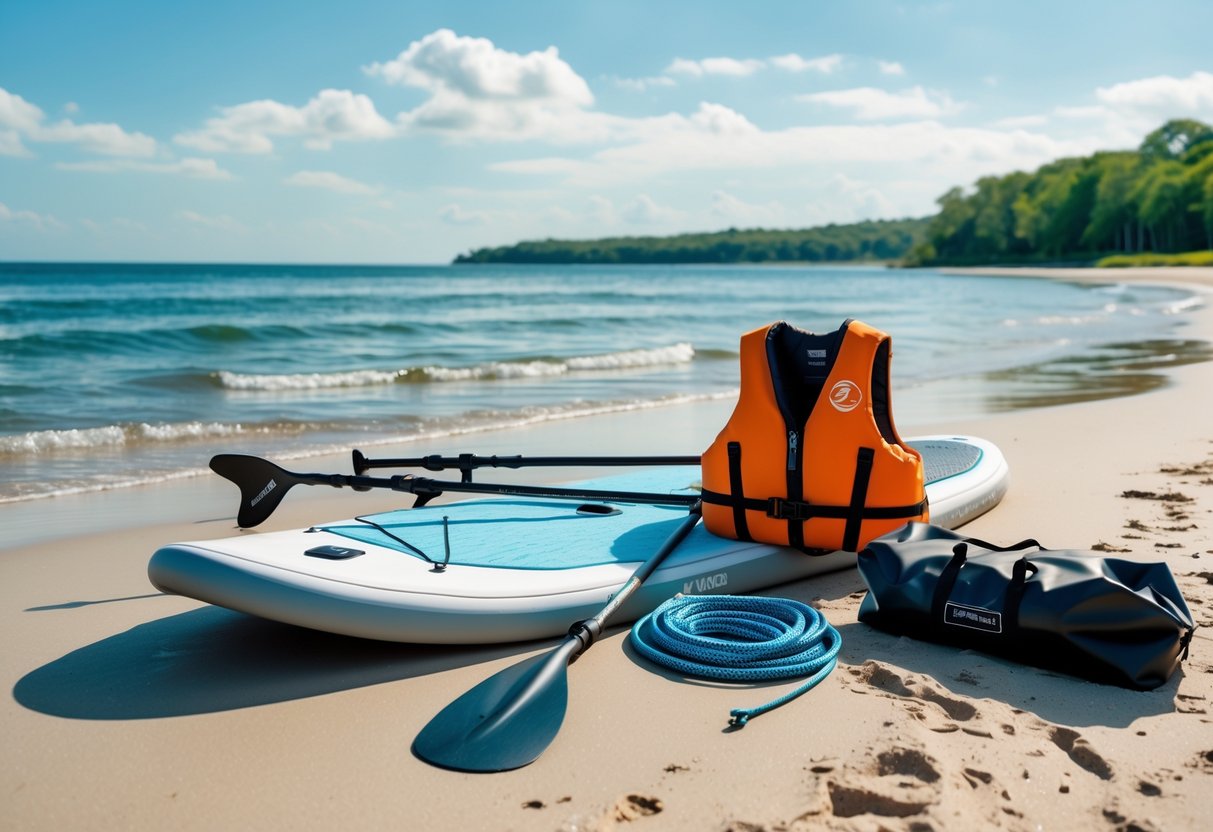
Getting out on the water requires specific gear to paddle safely and comfortably. The right board, paddle, and safety equipment make the difference between a good day and a frustrating experience.
Stand Up Paddleboard Types
I recommend choosing between three main board categories based on where you’ll paddle. All-around boards measure 10 to 12 feet long and work well for beginners in calm water. They’re stable and forgiving, which helps you build confidence quickly.
Touring boards are longer and narrower, typically 12 to 14 feet. I use these for covering distance efficiently on lakes and bays. They track straighter than all-around boards but require better balance.
Surf SUPs are shorter and more maneuverable, usually under 10 feet. These boards handle waves and choppy conditions better than other types.
Board construction matters too. Inflatable boards pack down for easy transport and storage. They’re durable and good for traveling. Hard boards offer better performance and speed but require more storage space and careful handling.
Selecting the Right Paddle
The paddle should reach my wrist when I stand it upright next to me. This length lets me paddle efficiently without straining my shoulders or back.
I look for adjustable paddles when starting out. They work for different paddlers and let me fine-tune the length as my technique improves. Fixed-length paddles weigh less and feel more solid but can’t be adjusted.
Blade size affects how much water I pull with each stroke. Larger blades move more water but tire me out faster. Smaller blades require more strokes but let me paddle longer without fatigue.
Material choices include aluminum, fiberglass, and carbon fiber. Aluminum paddles cost less but weigh more. Carbon fiber paddles are lightest and reduce arm fatigue on long trips.
Personal Flotation Devices and Safety Gear
I wear a Coast Guard-approved life jacket on every paddle. The law requires one for each person in most areas. I prefer inflatable belt-pack PFDs because they don’t restrict my movement.
A leash connects me to my board and prevents separation if I fall. I use a coiled leash for flatwater and a straight leash in surf. The leash attaches to my ankle or calf with a comfortable strap.
Essential safety items include:
- Whistle attached to my PFD for signaling
- Waterproof phone case for emergencies
- Sun protection like sunscreen, hat, and sunglasses
- Dry bag for storing keys and extra clothing
I also carry a basic repair kit with a pump and patch material for inflatable boards.
Paddleboarding Techniques
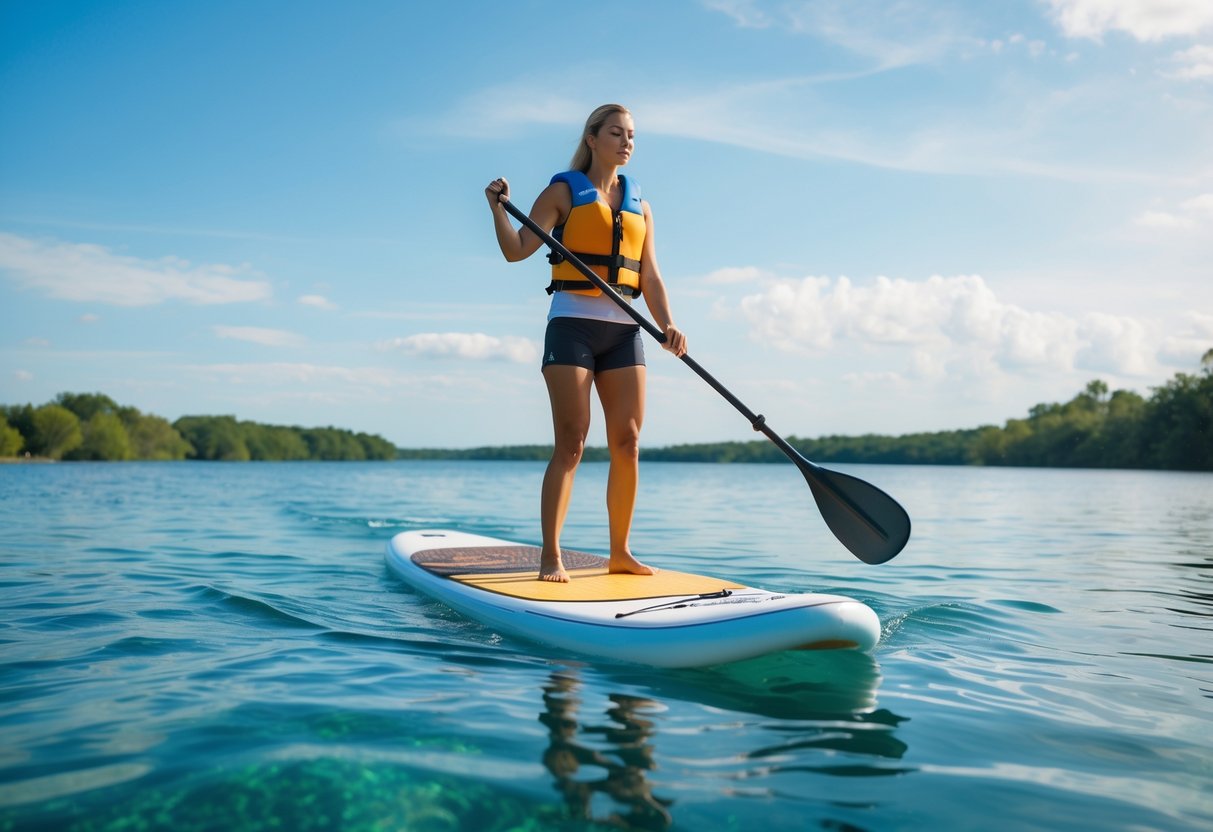
Mastering the right paddling strokes, steering methods, and balance techniques will transform your time on the water from shaky and uncertain to smooth and controlled.
Basic Paddling Strokes
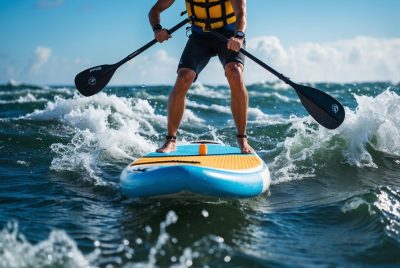
The forward stroke is the most important stroke to learn first. I grip the paddle with one hand on top of the handle and the other on the shaft, keeping my hands shoulder-width apart. The blade should angle away from me, not toward me.
To execute a proper forward stroke, I reach forward and plant the blade in the water near the nose of my board. I pull the paddle back through the water alongside the rail, using my core muscles instead of just my arms. The stroke ends at my ankle, and I lift the blade out cleanly.
I switch sides every 3-4 strokes to keep my board moving in a straight line. The backstroke works the same way but in reverse, which helps me slow down or move backward when needed.
For maximum power, I keep my bottom arm straight and pull with my top arm while twisting my torso. This technique uses larger muscle groups and prevents arm fatigue.
Turning and Steering Methods
The sweep stroke creates wide, arcing turns. I place the paddle blade in the water near the nose and sweep it in a wide arc toward the tail. This turns my board away from the paddling side.
A reverse sweep does the opposite. I start at the tail and sweep toward the nose, which turns my board toward the paddling side. These strokes work best when I lean slightly into the turn.
The pivot turn offers a faster option for changing direction. I move back on my board to lift the nose out of the water, then use short sweep strokes on alternating sides. My board spins quickly in place with this method.
For small course corrections, I can simply paddle on one side for a few extra strokes or use a slight sweep at the end of my regular forward stroke.
Maintaining Balance on the Board
I position my feet parallel to each other, roughly hip-width apart, over the board’s center handle. My knees stay slightly bent to absorb movement from the water below.
Looking at the horizon instead of down at my feet helps my balance significantly. When I focus on distant objects, my body naturally makes small adjustments to stay upright.
I engage my core muscles to maintain stability. A strong, engaged core acts as my center of balance and helps me respond to waves and wind. My weight stays centered over my feet rather than leaning too far forward or back.
When I feel unstable, I lower my center of gravity by bending my knees more rather than stiffening up. Relaxed, flexible positioning absorbs the board’s movement better than rigid, tense muscles.
Preparing for Your First Paddleboarding Session
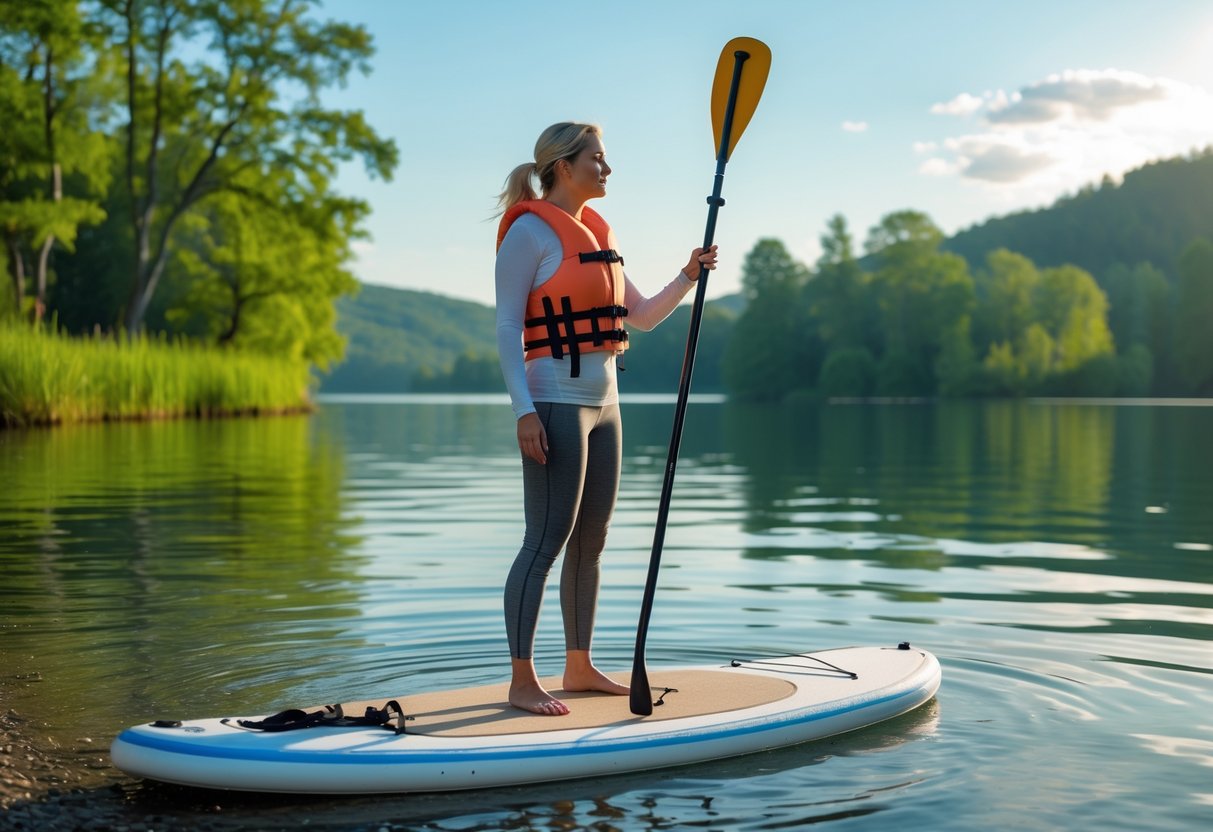
Getting ready for your first time on a paddleboard means picking a safe spot to practice, checking the weather and water, and getting your body ready to paddle.
Choosing the Best Location
I always tell new paddleboarders to start at a calm lake or protected bay. These spots have flat water and no waves, which makes learning much easier.
Look for locations with shallow water near the shore. This lets you practice standing up without worrying about deep water underneath you. I suggest finding areas where the water is 3-4 feet deep and you can see the bottom.
Stay away from busy boat traffic areas for your first few sessions. Boat wakes create waves that can knock you off balance while you’re still learning the basics.
Public beaches with designated paddle areas work well for beginners. These spots often have other paddleboarders around, which adds a safety factor. Plus, you can watch more experienced people and learn from them.
Check if the location has easy water entry points. Sandy beaches are better than rocky shores or areas with lots of seaweed and underwater obstacles.
Understanding Weather and Water Conditions
I check the wind forecast before every paddleboarding session. Winds under 10 mph are best for beginners. Anything stronger makes paddling difficult and can push you off course.
Early mornings usually offer the calmest conditions. Wind tends to pick up in the afternoon, so I schedule my beginner sessions between 7 AM and 10 AM.
Water temperature matters just as much as air temperature. Cold water below 60°F requires a wetsuit, even if the air feels warm. I never paddleboard alone in cold water.
Key conditions to check:
- Wind speed and direction
- Water temperature
- Wave height
- Visibility
- Thunderstorm forecasts
Avoid paddleboarding during storms, fog, or when small craft advisories are posted. These warnings exist for good reason.
Warming Up and Stretching
I spend 5-10 minutes warming up my body before getting on the board. This prevents muscle strains and helps me paddle longer.
Start with arm circles to loosen your shoulders. Do 10 circles forward and 10 circles backward. Your shoulders do most of the work while paddling, so they need to be ready.
Hip rotations prepare your core muscles for balance work. Stand with feet shoulder-width apart and rotate your hips in circles. Do 10 rotations each direction.
I also do simple torso twists to warm up my back and core. These muscles work constantly to keep you stable on the board. Light lunges help warm up your legs, which stay slightly bent while you paddle.
Dynamic stretches work better than static stretches before paddling. Save the deep stretching for after your session when your muscles are warm.
Safety on the Water
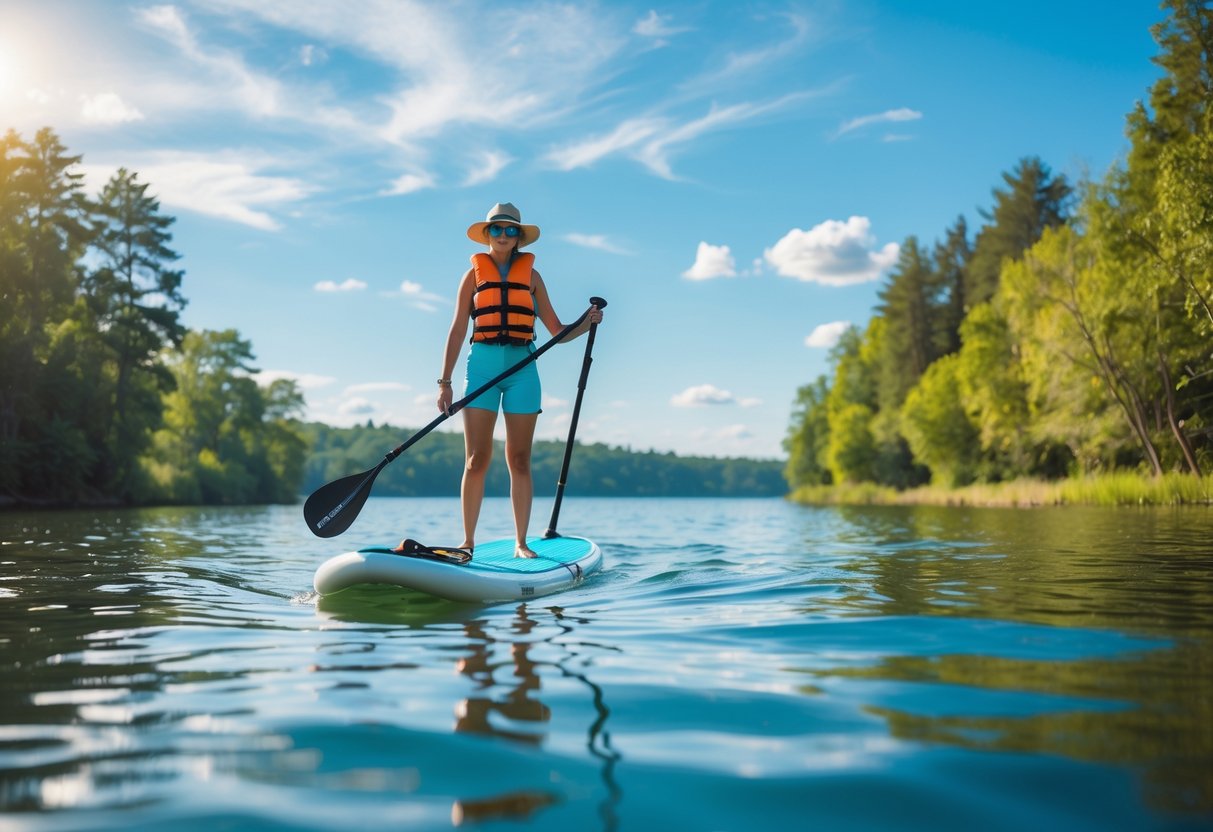
Paddleboarding puts you directly on the water, where conditions can change quickly and risks increase without proper preparation. I focus on three core areas: following basic water safety rules, understanding how currents and tides affect my board, and knowing how to rescue myself if I fall in.
Water Safety Rules
I always wear a personal flotation device (PFD) when paddleboarding. The U.S. Coast Guard classifies paddleboards as vessels, which means I’m required by law to have a PFD with me at all times.
I attach a leash to my ankle or calf before entering the water. This keeps my board from drifting away if I fall off, which is important because my board is my primary flotation device.
I check the weather forecast before every session. Wind speeds above 10 mph make paddling difficult, and storms create dangerous conditions. If I see lightning or hear thunder, I get off the water immediately.
Essential Safety Gear:
- Coast Guard-approved PFD
- Paddleboard leash
- Whistle or sound device
- Appropriate clothing for water temperature
I tell someone where I’m going and when I expect to return. I also paddle in designated areas and stay visible to other watercraft by avoiding boat channels when possible.
Dealing With Currents and Tides
I study tide charts before paddling in coastal areas or tidal rivers. Tides can create currents that move faster than I can paddle, making it impossible to return to shore.
I paddle against the current or wind during the first half of my session. This means I have assistance on the return trip when I’m more tired. If I get caught in a current pulling me away from shore, I paddle perpendicular to it rather than fighting directly against it.
Rip currents are narrow channels of fast-moving water that flow away from the beach. I identify them by looking for gaps in breaking waves, darker water, or foam and debris moving seaward. If caught in one, I paddle parallel to the shore until I’m out of the current’s pull.
Self-Rescue Techniques
I practice getting back on my board in calm, shallow water before paddling in deeper areas. The standard remount involves positioning myself near the center of the board, reaching across to the far rail, and pulling myself up while kicking my legs.
If I can’t remount, I stay with my board and use it for flotation. I never abandon my board to swim for shore unless I’m extremely close to land and certain I can make it safely.
In cold water, I get back on my board quickly to prevent hypothermia. If I can’t remount, I climb on top and lie flat to reduce heat loss. I keep my whistle accessible and use it to signal for help if needed.
Proper Paddleboarding Stance and Posture
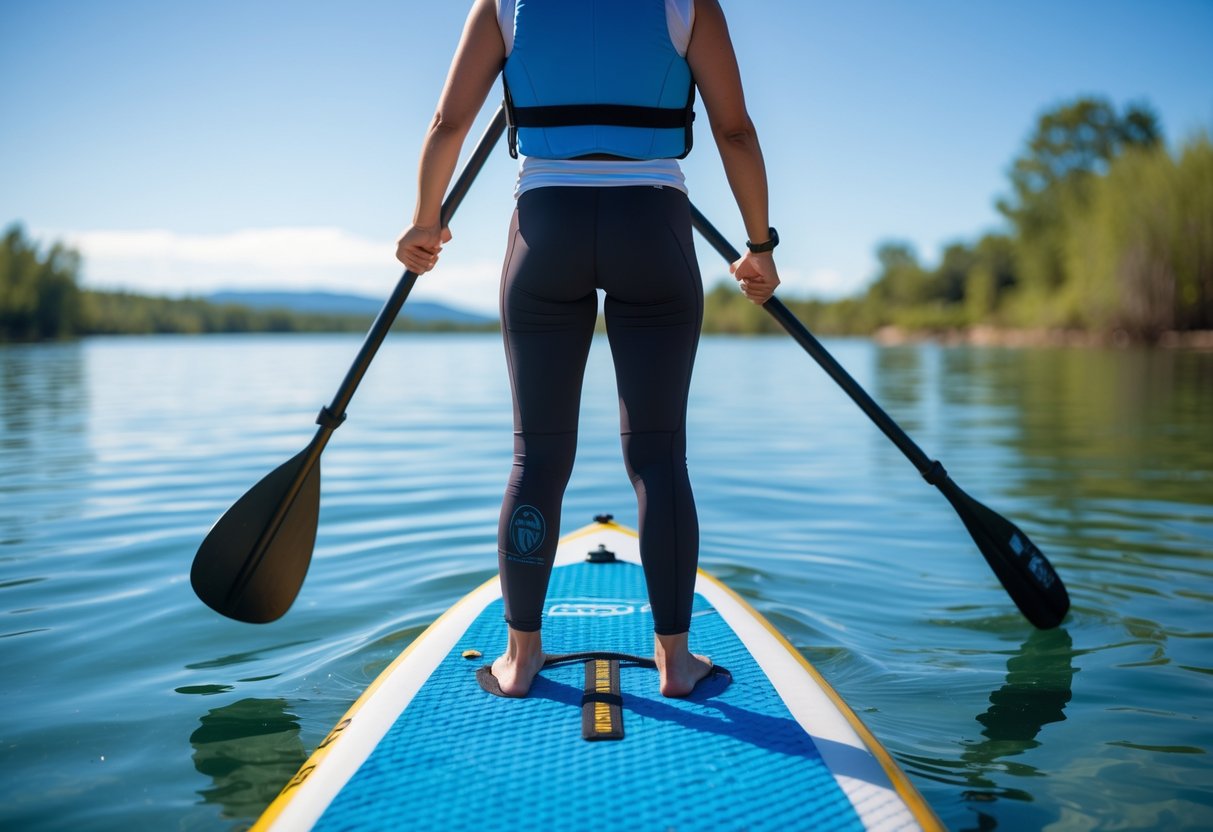
Your stance and posture determine how stable you feel on the water and how efficiently you can paddle. Getting these fundamentals right will help you stay balanced and reduce fatigue during longer sessions.
Foot Positioning
I recommend starting with your feet shoulder-width apart, positioned parallel to each other. This is called the neutral stance, and it gives you the most stability when you’re learning.
Your feet should be centered on the board, right over the carrying handle. This spot is the sweet spot where the board sits level in the water. If you stand too far forward, the nose dips down. If you stand too far back, the tail drags.
Keep your toes pointing forward and distribute your weight evenly across both feet. I find that planting my entire foot flat on the deck works better than staying on my toes. Your knees should have a slight bend, not locked straight.
As you get more comfortable, you can adjust your stance for different conditions. A staggered stance with one foot slightly forward works well in choppy water or when surfing waves.
Body Alignment
I keep my back straight and my core engaged while paddling. Slouching forward throws off your balance and makes every stroke harder than it needs to be.
Your hips should stay centered over the board. I think of my body as stacked vertically: ankles, knees, hips, and shoulders all aligned. This neutral position lets me respond quickly to changes in water conditions.
Look at the horizon, not down at your feet. Your head position affects your whole body, and looking down pulls your weight forward. Keep your shoulders relaxed and level, not hunched up toward your ears.
Engage your core muscles to maintain stability. I tighten my abdominal muscles slightly, which helps me stay balanced without relying only on my legs.
Common Mistakes to Avoid
Standing too far back or forward on the board is the mistake I see most often. This throws off the board’s trim and makes it harder to control. Always check that you’re near the center handle.
Keeping your legs completely straight is another problem. Locked knees prevent you from absorbing the water’s movement. I maintain a slight bend in my knees at all times.
Many beginners look down at their feet instead of ahead. This shifts your center of gravity forward and increases your chances of falling. Keep your gaze on the horizon or where you want to go.
Gripping the paddle too tightly in your hands wastes energy and causes arm fatigue. The same goes for tensing your whole body. I stay loose and relaxed while keeping my core engaged.
Transporting and Storing Your Paddleboard
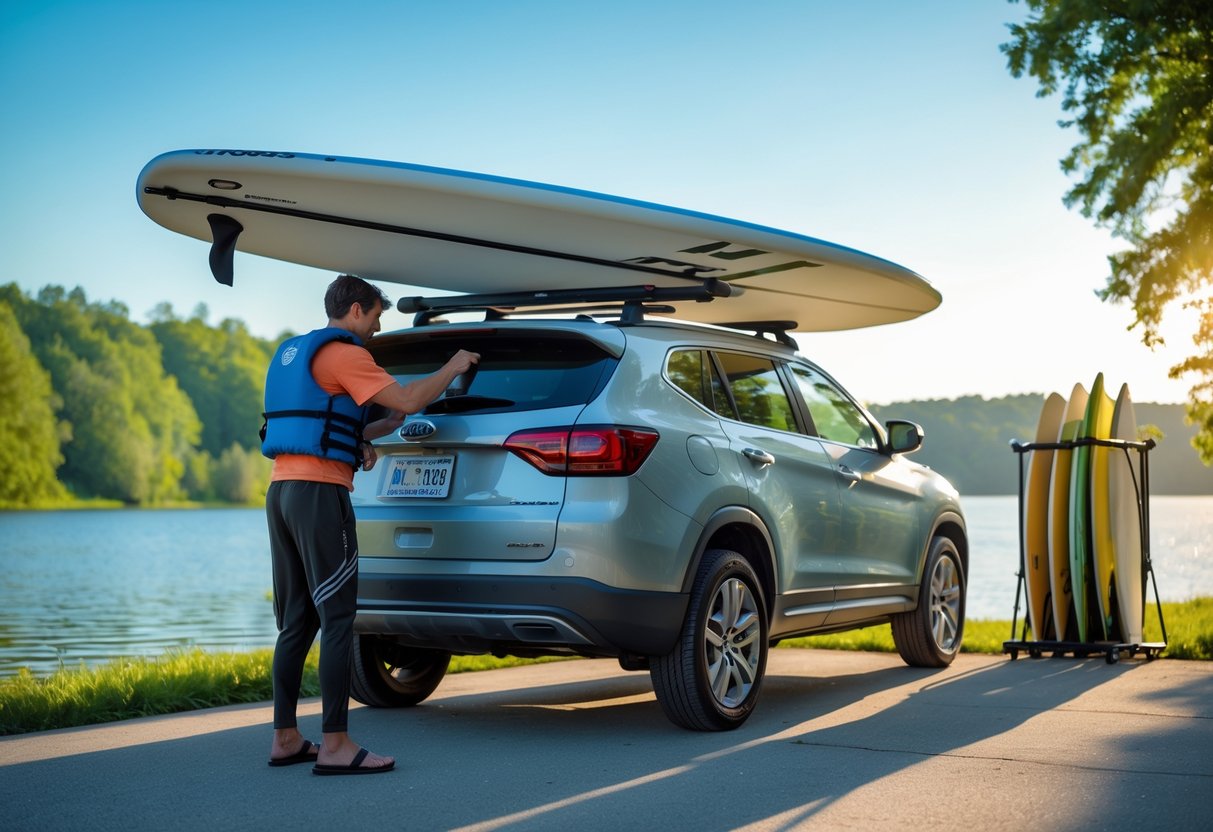
Getting your board to the water and keeping it in good shape requires the right techniques. I’ll cover the best ways to carry, transport, and store your paddleboard to protect your investment.
Carrying Methods
I recommend learning proper carrying techniques before your first trip to the water. The most common method is the side carry, where you hold the board under your arm with the fin facing away from your body. This works well for short distances.
For longer walks, I use the shoulder carry. Place the board on your shoulder with the fin toward the front and your hand on the opposite rail for balance. The carry handle at the center of the board makes this easier.
When the wind picks up, I keep the board on my downwind side. This prevents the board from catching the wind and pulling you off balance. If you need both hands free for a moment, set the board down with the fin up to avoid damage.
Transportation Options
With roof racks, I place the board deck-down on foam pads or rack pads. I use cam straps or tie-down straps to secure the board at two points. The straps should be snug but not overly tight to avoid denting the board.
Without roof racks, I use foam blocks that sit on top of my car. I position two blocks on the roof, place the board on top, and run straps through the car’s interior. I always make sure the doors can still close properly.
For truck beds, I lay the board flat with a towel or pad underneath. If the board hangs over the tailgate, I secure it with straps and add a red flag for safety.
Storage Tips
I always clean my board with fresh water after each use. Salt water and dirt can damage the board over time. I let it dry completely before storing it to prevent mold growth.
I store my board in a cool, dry place away from direct sunlight. UV rays can fade and weaken the board material. I prefer storing the board on its side or hanging it on wall racks to prevent warping.
I never leave my board in a hot car for extended periods. Heat can cause the board to delaminate or lose its shape.
Building Skills and Endurance
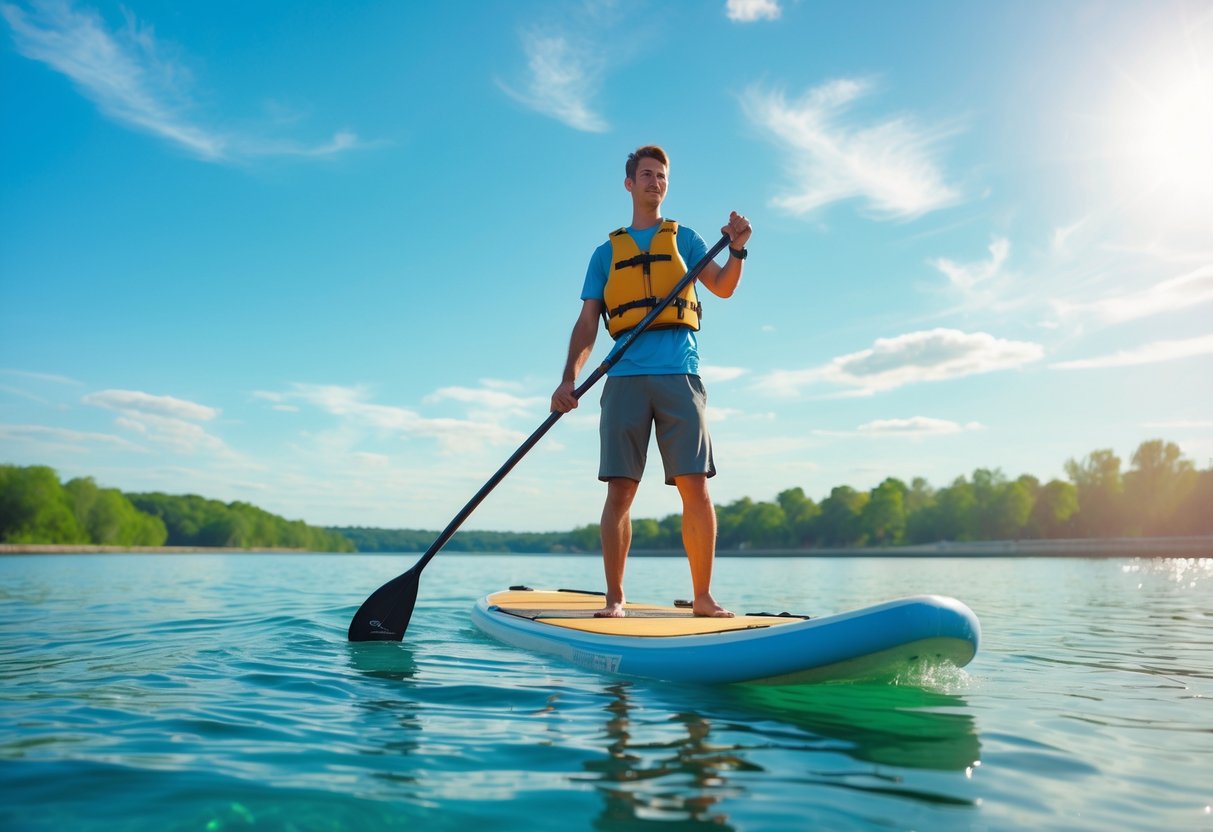
Getting better at paddleboarding takes regular practice and focused training. I’ll show you specific drills to master the basics and exercises that build the core strength and balance needed for longer paddle sessions.
Beginner Drills and Exercises
I recommend starting with short 15-20 minute sessions in calm water to build your foundation. Practice your stance by keeping your feet hip-width apart and parallel to each other, with knees slightly bent.
For paddling technique, I focus on three key drills. First, practice the forward stroke by reaching the paddle blade fully forward and pulling it straight back alongside the board. Second, work on switching sides every 4-6 strokes to maintain a straight path. Third, practice pivot turns by sweeping the paddle in wide arcs from front to back.
Off the water, I include these exercises in my routine:
- Planks: Hold for 30-60 seconds to build core stability
- Squats: 3 sets of 15 reps for leg strength
- Burpees: 2 sets of 10 for cardiovascular endurance
- Rowing motions: Use resistance bands to mimic paddle movements
I suggest paddling 2-3 times per week initially. This frequency allows my muscles to recover while building consistent skills.
Improving Balance and Strength
Core strength is the foundation of good balance on a paddleboard. I prioritize exercises that engage my entire midsection, including obliques and lower back muscles.
My go-to strength exercises include side planks for 30 seconds per side and Russian twists with light weight. These target the rotational muscles I use during every paddle stroke. I also practice single-leg stands on an unstable surface like a cushion to improve my balance on the water.
For building paddling endurance, I gradually increase my time on the water by 5-10 minutes each session. Swimming and cycling also boost my cardiovascular fitness, which translates directly to longer paddle sessions without fatigue.
Balance drills on the board include practicing weight shifts from side to side and doing gentle squats while floating in calm water. I find these movements help me feel more confident when conditions get choppy.
Exploring Paddleboarding Disciplines
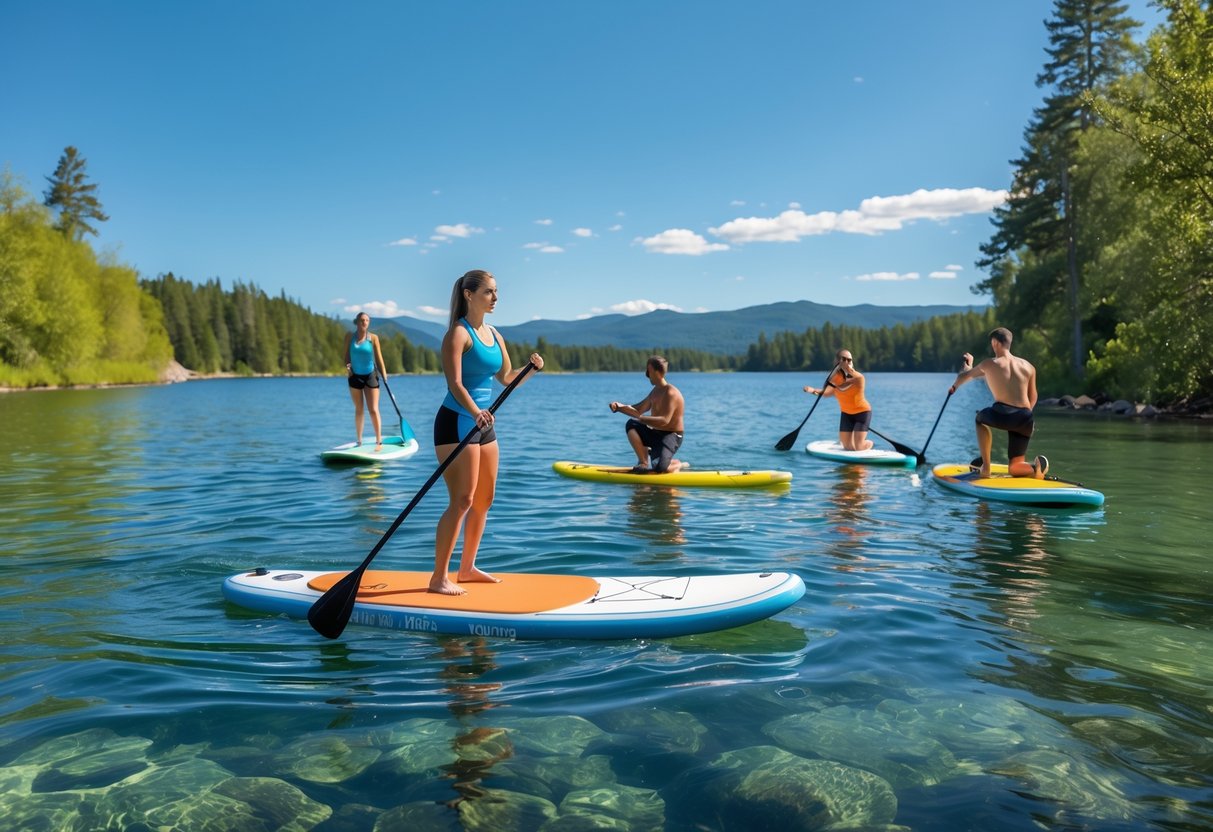
Paddleboarding offers different ways to enjoy the water, from casual floating to challenging wave riding. Each discipline requires specific skills and equipment suited to its unique demands.
Recreational Paddleboarding
Recreational paddleboarding is the most common way people enjoy this sport. I find it’s perfect for beginners because it focuses on simple, relaxed paddling on calm water like lakes, bays, and slow-moving rivers.
The main goal is to cruise at your own pace while taking in the scenery. You don’t need special skills beyond basic paddling and balance. Most recreational paddlers use all-around boards that measure 10 to 12 feet long and 30 to 34 inches wide, which provide good stability.
I recommend this discipline if you want low-impact exercise or a peaceful way to explore waterways. You can paddle alone or with friends, stop to swim, or even bring a pet along. The flexible nature of recreational paddleboarding means you can paddle for 20 minutes or several hours based on your fitness level and interest.
SUP Yoga
SUP yoga combines traditional yoga poses with the challenge of balancing on a paddleboard. I’ve seen this discipline grow quickly because it adds an extra element to standard yoga practice.
The unstable surface of the board forces your core muscles to work harder during each pose. You’ll need a wider, more stable board than standard models, usually 32 to 36 inches wide with a soft, grippy deck pad. I always practice in calm, shallow water where there’s minimal boat traffic and wind.
Basic poses work best on the water. Think downward dog, warrior poses, and seated stretches rather than complex balancing acts. The water adds difficulty to poses that feel easy on land. You might fall in, which is part of the experience and helps you learn to stay calm when you lose balance.
SUP Surfing
SUP surfing takes paddleboarding into ocean waves where you ride swells like a traditional surfer. I consider this the most physically demanding paddleboarding discipline because it requires strong paddling skills, wave knowledge, and quick reflexes.
The boards used for SUP surfing are shorter and narrower than recreational models, typically 7 to 10 feet long. This smaller size allows for sharper turns and better maneuverability on wave faces. You’ll also use a shorter paddle than in flat-water paddling.
I suggest mastering flat-water paddleboarding first before attempting SUP surfing. You need to understand ocean conditions, including how to read waves, navigate currents, and avoid other surfers. The learning curve is steep, but riding a wave while standing gives you a unique perspective that traditional surfing can’t match.
Eco-Friendly Paddleboarding Practices
Paddleboarding gives me a unique connection to the water, but it also comes with a responsibility to protect the environments I explore. I can make simple choices that reduce my impact and help preserve waterways for future paddlers.
Minimizing Environmental Impact
I choose gear made from recycled or sustainable materials when possible. Many companies now make boards from eco-friendly materials that perform just as well as traditional options.
I always use reef-safe sunscreen to protect marine life. Regular sunscreen contains chemicals that harm coral reefs and fish. I also bring a reusable water bottle instead of disposable plastic ones.
When I clean my paddleboard, I use biodegradable cleaning products. These products break down naturally and don’t release harmful chemicals into the water. I clean my board away from the water’s edge to prevent any runoff from entering the ecosystem.
I participate in waterway clean-ups whenever I can. Picking up trash while paddling takes minimal effort but makes a real difference. Even collecting a few pieces of litter during each outing helps keep our waters clean.
Respecting Wildlife and Habitats
I maintain a safe distance from all wildlife I encounter on the water. Getting too close can stress animals and disrupt their natural behaviors. I keep at least 50 feet away from most wildlife and even farther from nesting birds or marine mammals.
I avoid paddling through sensitive areas like seagrass beds, coral reefs, and marsh grasses. These habitats are fragile and damage easily. I stay in designated channels and deeper water to protect underwater vegetation.
I never feed wildlife from my board. Human food harms animals and changes their natural feeding patterns. I also keep noise levels down to avoid disturbing birds and other creatures.
I research local wildlife before paddling in new areas. This helps me understand what species live there and how to protect them. Some areas have seasonal restrictions to protect nesting or breeding animals.
Frequently Asked Questions
New paddleboarders often have similar questions about equipment, balance, and safety. I’ve gathered the most common concerns to help you start your paddleboarding journey with confidence.
What should beginners know before starting stand up paddleboarding?
I recommend starting on calm, flat water like a lake or protected bay. These conditions make it easier to learn basic skills without fighting waves or currents.
You’ll need three essential pieces of equipment: a paddleboard, a paddle, and a personal flotation device. A wide board around 32 to 34 inches provides the stability most beginners need.
I suggest wearing appropriate clothing for the water temperature, not the air temperature. You should also apply waterproof sunscreen and bring water to stay hydrated.
What techniques are essential for staying balanced on a paddleboard?
I keep my feet parallel and hip-width apart, positioned in the center of the board. Your feet should be on either side of the carry handle.
Bend your knees slightly and keep your core engaged. I find that looking at the horizon instead of down at my feet helps maintain balance.
Your paddle acts as a third point of contact with the water. I use it to brace myself when I feel unsteady.
Can you provide some basic paddleboarding instructions for first-time participants?
I start by kneeling on the board in the center. Once I feel stable, I place one foot where my knee was, then bring up the other foot.
Hold the paddle with one hand on the top grip and the other on the shaft. The blade should angle forward, away from you.
I keep my arms relatively straight and rotate from my torso when paddling. This technique uses your core muscles instead of just your arms, which reduces fatigue.
Switch sides every few strokes to keep the board moving straight. I paddle on the right side to turn left, and on the left side to turn right.
What are the safety rules and guidelines to follow while paddleboarding?
I always wear a Coast Guard-approved personal flotation device. In many areas, this is required by law.
Check the weather forecast before heading out. I avoid paddling in high winds, storms, or when small craft advisories are posted.
I use a leash that connects my ankle to the board. This keeps the board close if I fall off, which is important because your board is your primary flotation device.
Stay aware of your surroundings, including other boats, swimmers, and obstacles. I also let someone know where I’m going and when I expect to return.
How does one choose the right paddleboard for their skill level and activities?
I recommend inflatable SUPs for beginners because they offer good stability and are easier to store and transport. They’re also more forgiving if you fall.
Board width matters more than length for stability. I suggest boards at least 32 inches wide for your first purchase.
Consider your weight when selecting a board. Each board has a weight capacity, and staying within that range improves performance and stability.
Think about how you’ll use the board. All-around boards work well for recreational paddling, while longer boards are better for covering distance.
What are the best practices for paddleboarding in varying water conditions?
I start on flat, calm water like small lakes or protected bays. These conditions let you focus on technique without environmental challenges.
For moving water or mild currents, I paddle upstream first while I have the most energy. This makes the return trip easier.
In choppy conditions, I widen my stance and lower my center of gravity by bending my knees more. Sometimes I drop to my knees for added stability.
I avoid paddling in offshore winds that could push me away from shore. Onshore winds are safer because they blow you back toward land.